Reliability isn’t one system – it’s protection, control, SCADA, and distribution automation staying in sync. Here’s what that looks like on real DST Engineers projects.
“More Reliability” Usually Means Precision, Not Just New Equipment
When utilities ask for “more reliability,” what they’re really asking for is precision: devices that trip when they should, hold when they must, and talk to each other without friction. That precision is exactly where protection and control systems, robust SCADA system design, and advanced distribution automation meet to lift grid performance in measurable ways. It’s also where DST Engineers does some of its most impactful work.
What Precision Looks Like on a Live Feeder
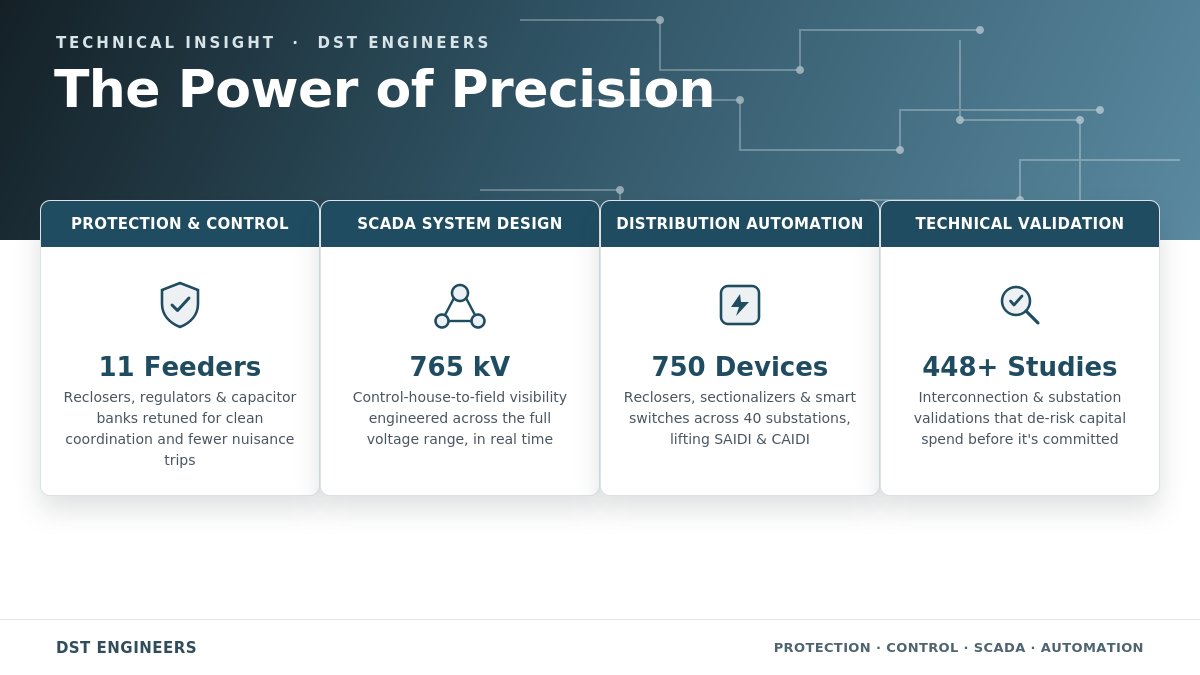
On paper, protective devices coordinate neatly. In the field, a single fuse left in an outdated scheme or a recloser set a touch too slow can cascade into avoidable outages. Our team tunes that last mile of detail. In a recent program for a major Mid-Atlantic utility, we optimized reclosers, regulators, and capacitor banks, producing CYME DIST models, CYME TCC coordination files, and annotated device settings so construction and operations had one authoritative view.
Result: smooth solar integration on eleven express feeders and fewer nuisance operations.
Reference: Case Study – Distribution Protection and Coordination Studies.
SCADA System Design That Shortens Every Outage
Great protection schemes need great visibility. Our Substation Engineering practice includes SCADA System Design, Automation and Integration, and Testing and Commissioning — from control house design to grounding and communications. We regularly engineer systems through 765 kV and deliver them with toolchains such as ASPEN OneLiner, ABB ADMS, CygNet, ClearSCADA, RTScada, Monarch, Ignition, and AutoCAD Electrical, so the control room sees exactly what field devices are doing, in real time.
Advanced Distribution Automation, at Scale
Scale matters. For a leading investor-owned utility (IOU), we’re leading a multi-division advanced distribution automation program: 250 intelligent devices deployed in 2025 and 500 targeted for 2026 – reclosers, sectionalizers, and SCADA smart switches coordinated across 40 substations. Our role covers full program operations – budget, schedule, and a 100-person deployment team – to raise reliability metrics like SAIDI and CAIDI by improving fault detection, isolation, and service restoration.
Reference: Case Study – Program Management for Advanced Distribution Automation.
Technical Validation When the Stakes Are High
Capex decisions benefit from a second set of expert eyes. For a global building systems manufacturer in New York, we performed technical validation on a substation expansion – stress-testing 34.5 kV feeder extension design, load handling, and protection philosophy; verifying transformer loading; and flagging potential over-design. The outcome: targeted design optimizations, tuned breaker ratings, a dual-secondary transformer strategy, and adherence to IEEE 1366 and NESC C2-2023, with cost clarity for leadership.
Reference: Case Study – Substation Expansion for Schluter Facilities.
Smarter Interconnections, Smoother Approvals
Interconnections rise or fall on the quality of studies and how quickly issues get resolved. In the Interconnection Studies Program, we executed 448+ studies (384 Level 1, 2 Level 2, 62 Level 4), used CYME for system impact and feasibility, and automated one-line diagrams, project drawings, and cost estimates so utility stakeholders could act without delays. Where upgrades were needed, we identified reconductoring, capacitor banks, and relay adjustments; for a separate 3.25 MW PV project, we delivered settings, automation devices, and post-installation testing to integrate cleanly into a 34 kV scheme.
Reference: Case Study – DER Interconnection Studies Program.
Under the Hood: Our Engineering Stack
Whether we’re validating a hosting capacity study or commissioning a P&C scheme, our toolchain is designed for traceability and repeatability:
- Planning & studies: CYME, ETAP, PSS/E, PSCAD
- P&C & relay coordination: ASPEN OneLiner
- SCADA & operations: ABB ADMS, CygNet, ClearSCADA, Ignition
- Lines & civil: PLS-CADD, PLS-Pole
- GIS & asset systems: ArcGIS, Maximo
People Who’ve Done This Before
Programs don’t succeed on software alone. They succeed on the judgment of the engineers using it. Our bench includes a Substation Protection & Control Lead with 16+ years designing and commissioning systems up to 345 kV (including relay and SCADA leadership), and a Lead Substation Engineer with 25+ years across 12–765 kV upgrades and smart-grid integration. Their playbooks set the tone for quality and compliance in the field.
Why DST Engineers
- Full-service, utility-focused: distribution planning, substation design and automation, transmission engineering, and field services under one roof
- Licensed nationwide: PE licenses in all 50 U.S. states, NMSDC-certified, and a record of safety built on zero recordable incidents so we can mobilize where you operate
- From model to make-ready: we don’t hand off a study and walk away; we produce IFC packages, settings files, commissioning plans, and operator-ready documentation that cut through startup friction
How We Engage (Fast Path to Value)
- Discovery & data hygiene – pull existing one-lines, device inventories, and comms maps; reconcile discrepancies so the model reflects reality
- Model & coordination – build/validate CYME or PSS/E cases; run TCC and miscoordination sweeps; draft relay settings with target margins and lockout logic
- SCADA architecture – define point lists, protocols, network pathways, and failover; map HMI alarm priorities to operational playbooks
- Pilot automation – select candidate circuits for FLISR and voltage optimization; evaluate SAIDI/CAIDI impact and device density before scaling
- Technical validation – stress-test design and costs; align to IEEE/NESC and utility standards; document changes that reduce lifecycle risk
- IFC & commissioning – deliver sealed drawings, settings, test plans, and as-builts; train operators; close lessons-learned loop with construction
What You Gain
- Faster fault isolation and restoration through advanced distribution automation
- Fewer nuisance trips via tuned protection and control systems
- Fewer blind spots thanks to resilient SCADA system design
- Board-ready technical validation that de-risks spend and keeps projects moving
Let’s Talk About Your Grid
Schedule an introductory call with Abdul Mannan, Marketing & Business Development Lead, at 708-667-7841 or Abdul.Mannan@dstengineers.com.
Frequently Asked Questions
What is SCADA in a power distribution system?
SCADA (Supervisory Control and Data Acquisition) is the system that lets operators monitor and control field devices – like reclosers, breakers, and capacitor banks — in real time from a central control room, using data collected from remote terminal units (RTUs) and intelligent electronic devices (IEDs) out on the network.
How does distribution automation improve SAIDI and CAIDI?
Distribution automation improves SAIDI (System Average Interruption Duration Index) and CAIDI (Customer Average Interruption Duration Index) by automating fault detection, isolation, and service restoration (FLISR) — cutting the time between an outage occurring and power being restored, often from hours to seconds or minutes for automated switching operations.
Why do protection and control settings need to be coordinated across a feeder?
Uncoordinated protective devices can trip out of sequence, causing a fault on one section of a feeder to black out customers well beyond the actual problem area. Coordination studies (TCC analysis) ensure each device operates in the right order and only isolates the smallest necessary section of the system.