
Aging infrastructure, rising demand, and renewable integration make asset management a strategic function, not a maintenance afterthought. Here’s a working framework.
Introduction
In today’s rapidly evolving energy landscape, utilities across North America face mounting pressures: aging infrastructure, increasing demand, and the need to integrate renewable energy into existing systems. Effective asset management for utilities is no longer optional — it’s a strategic necessity.
At DST Engineers, we build engineering programs around each utility’s specific system, workforce, and regulatory environment — helping teams streamline operations, extend asset lifecycles, and execute upgrades efficiently. This guide lays out the framework we use to help utilities get more value from every infrastructure dollar.
1. Why Asset Management Matters for Utilities
Utility companies operate in a high-stakes environment. Equipment failures, unplanned outages, and inefficient processes carry steep costs — in emergency repairs, regulatory exposure, and customer trust. A proactive approach to managing those assets delivers:
- Improved system reliability
- Reduced operational risks
- Optimized maintenance schedules
- Smarter capital investment decisions
DST Engineers brings hands-on experience with the specific challenges North American utilities face — and delivers solutions built to hold up in real-world field conditions.
2. Tailored Engineering Services for Utility Success
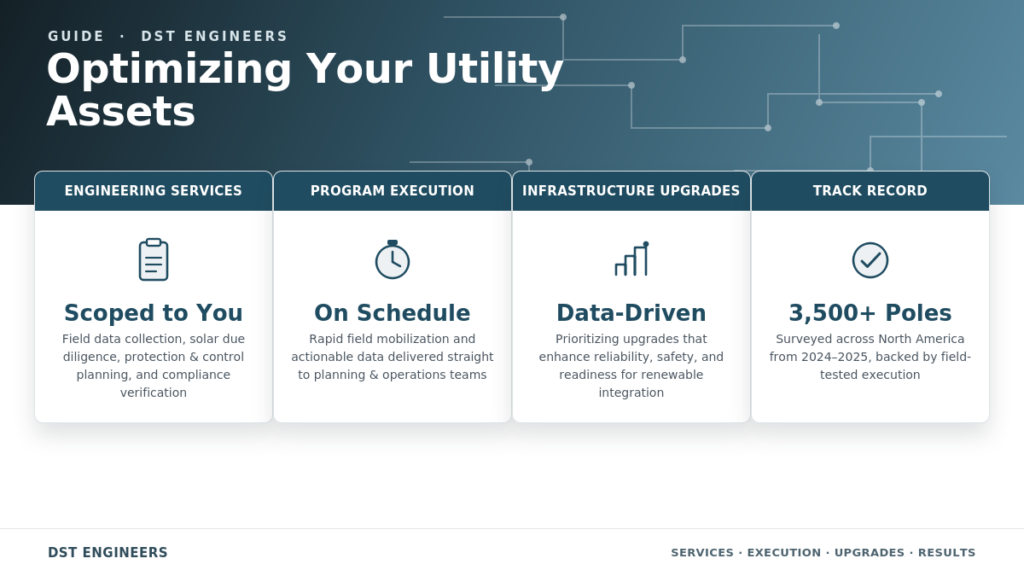
Every utility is different, which is why we scope each engagement rather than force a one-size-fits-all approach. Our services include:
- Field data collection & documentation (e.g., pad-mount transformer surveys)
- Solar engineering and renewable project due diligence
- Advanced protection & control system planning
- Asset verification and reporting for compliance and safety
Our approach combines precision, safety, and innovation to align with your utility’s strategic goals.
3. Efficient Program Execution
Utilities cannot afford delays. Most asset management programs don’t fail on strategy — they fail on execution: slow field mobilization, data that doesn’t reach planning teams in a usable format, or rework caused by poor communication between field and office. Our field-tested approach keeps programs moving by:
- Deploying qualified field teams with rapid mobilization capability
- Delivering actionable datasets for planning and operations teams
- Maintaining proactive communication to avoid costly rework
- Executing projects quickly while adhering to strict safety protocols
By keeping projects on schedule and within scope, we help utilities reduce oversight burden and focus resources where they matter most.
4. Infrastructure Upgrades That Drive Reliability
Aging infrastructure remains one of the greatest challenges facing the North American utility market. Rather than replacing equipment on a fixed age schedule, DST Engineers supports utilities with data-driven insights to prioritize infrastructure upgrades that:
- Enhance grid reliability
- Improve safety and compliance
- Extend the lifespan of existing assets
- Prepare systems for future demand and renewable integration
Our combination of engineering expertise and actionable reporting helps utilities plan upgrades with confidence.
5. Why Partner with DST Engineers?
Choosing DST Engineers means gaining a trusted ally committed to your long-term success. We deliver:
- A track record – surveyed 3500+ poles from 2024-2025
- Deep expertise in both traditional and emerging utility infrastructure
- Commitment to high-quality standards, safety, and client satisfaction
As utilities embrace the energy transition, DST Engineers provides the tools, knowledge, and execution needed to thrive.
Conclusion
Optimizing utility assets is about more than maintenance — it’s about building resilient, future-ready infrastructure. Utilities that partner with DST Engineers gain a team that executes programs on schedule, scopes engineering to their real needs, and prioritizes the upgrades that move the needle on reliability.
Ready to optimize your utility assets? Schedule a consultation with DST Engineers.
Frequently Asked Questions
What is utility asset management?
Utility asset management is the practice of tracking, maintaining, and prioritizing capital investment in physical grid infrastructure — poles, transformers, substations, and lines — based on condition data and risk, rather than fixed replacement schedules, with the goal of maximizing reliability per dollar spent.
How often should utilities survey field assets like pad-mount transformers?
There’s no universal interval — it depends on asset age, criticality, and environmental exposure — but many utilities run baseline condition surveys every 3–5 years for critical distribution assets, supplemented by targeted inspections after major storm events or known failure trends.
What’s the difference between reactive maintenance and asset management?
Reactive maintenance repairs or replaces equipment after it fails. Asset management uses condition data and risk scoring to intervene before failure, which is typically far cheaper than emergency repair and avoids the reliability and customer-trust cost of unplanned outages.
Lorem ipsum dolor sit amet, consectetur adipiscing elit. Ut elit tellus, luctus nec ullamcorper mattis, pulvinar dapibus leo.