
Reliable electricity is critical for modern communities, businesses, healthcare facilities, and industrial operations. However, distribution systems face increasing challenges from extreme weather events, aging infrastructure, vegetation impacts, equipment failures, and evolving grid requirements. Utilities are increasingly investing in feeder hardening strategies to improve system resilience, reduce outage impacts, and enhance restoration capabilities.
Looking to get your next engineering project completed with expert support? Explore DST’s Services to learn how DST can support your project.
What Is Feeder Hardening?
Feeder hardening refers to the engineering process of strengthening distribution feeders by improving physical infrastructure, protection systems, and operational capabilities to reduce outage risks and improve reliability.
Hardening measures can include:
- Upgrading poles, crossarms, and supporting structures
- Replacing aging conductors and distribution equipment
- Improving protective device coordination
- Installing sectionalizing devices and smart grid technologies
- Addressing vegetation management risks
- Relocating or undergrounding vulnerable facilities
- Supporting distribution automation and faster fault isolation
- Improving feeder design and system configuration
Why Is Feeder Hardening Important?
Many electrical distribution systems include infrastructure that has been in service for many years. As systems age, they may become more vulnerable to equipment failures and environmental conditions.
At the same time, utilities are managing new challenges, including:
- Extreme weather events
- Increasing electricity demand
- Aging infrastructure
- Integration of distributed energy resources (DERs)
- Growing expectations for reliable electricity
Feeder hardening helps utilities identify vulnerable parts of the system and make improvements that reduce the risk and impact of outages.
The goal is not always to eliminate every possible outage. Instead, feeder hardening helps make the system stronger, more reliable, and better prepared to recover when problems occur. Many utilities use reliability metrics such as SAIDI (System Average Interruption Duration Index), SAIFI (System Average Interruption Frequency Index), and CAIDI (Customer Average Interruption Duration Index) to evaluate system performance and identify feeders that may benefit from hardening improvements.
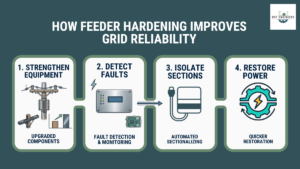
How Does Feeder Hardening Improve Grid Reliability?
1. Strengthens Distribution Infrastructure
One of the main benefits of feeder hardening is stronger infrastructure.
For example, utilities may upgrade poles, conductors, crossarms, and other equipment to improve their ability to withstand challenging operating conditions.
These improvements may include replacing deteriorated poles, upgrading conductor capacity, improving clearance compliance, reinforcing structures, and upgrading protective devices based on field assessments and engineering studies.
2. Helps Reduce the Impact of Outages
When a failure occurs on a distribution feeder, it can interrupt service to many customers.
Hardening and modernizing feeder infrastructure can help reduce the number of failures and limit the impact of certain events. Improved system design and protective equipment can also help utilities isolate problems more effectively.
This supports one of the main goals of grid reliability: keeping as much of the electrical system operating as possible when a disturbance occurs.
3. Supports Faster Fault Detection and Restoration
Feeder hardening can work alongside distribution automation and protection systems.
Technologies and strategies such as sectionalizing, protective coordination, and FLISR (Fault Location, Isolation, and Service Restoration) can help utilities quickly identify faults, isolate affected sections, and restore power to unaffected customers. FLISR systems use automated switching devices, communication systems, and control logic to improve restoration times.
This is especially important for utilities working to improve outage response and overall system reliability.
4. Supports Long-Term Grid Modernization
Feeder hardening is also an important part of long-term system planning.
As electricity demand grows and more distributed energy resources, such as solar PV, are connected to the grid, utilities need distribution systems that can safely and reliably support changing power flows and operating conditions.
This makes feeder planning, system studies, and infrastructure improvements increasingly important.
How DST Engineers Supports Feeder Hardening Projects
At DST Engineers, feeder hardening is closely connected to several of our technical offerings.
DST Engineers supports utility feeder hardening initiatives by providing engineering, design, and project support throughout the lifecycle of distribution improvement projects. Our team works with utilities to evaluate existing infrastructure, develop engineering solutions, and support implementation of reliability improvements.
These services help utilities address aging infrastructure, improve feeder performance, and support modernization initiatives across their distribution networks.
- Distribution feeder assessments
- Pole loading and structural evaluations
- Distribution automation design
- SCADA device integration
- Utility standards compliance
- Construction package development
- Field verification and GIS updates
Conclusion
As utilities continue modernizing their distribution networks, feeder hardening will remain a key strategy for improving reliability, resilience, and customer service. Through engineering analysis, system upgrades, and practical design solutions, utilities can build distribution networks that are better prepared for future challenges.Effective feeder hardening combines sound engineering, field data, utility standards, and system planning to create practical improvements that deliver long-term value.
FAQs
- What is feeder hardening?
Feeder hardening strengthens electrical distribution infrastructure to improve reliability and resilience.
- Why is feeder hardening important?
It helps reduce outages and improves the system’s ability to withstand challenging conditions.
- What does feeder hardening include?
It may include stronger poles, upgraded conductors, improved equipment, and system upgrades.
- How does feeder hardening improve grid reliability?
It reduces infrastructure vulnerabilities and supports faster fault isolation and service restoration. - How does DST Engineers support feeder hardening?
DST Engineers supports feeder hardening through distribution feeder assessments, pole loading and structural evaluations, distribution automation design, SCADA integration, construction package development, field verification, and GIS support.