
You’re planning a new feeder, development, or distribution upgrade and need to determine whether the system should be installed overhead or underground. Utilities, developers, and municipalities must consider reliability, construction conditions, right-of-way (ROW), maintenance, cost, safety, and long-term system performance.
Overhead systems are generally accessible and easier to inspect and repair, while underground systems can reduce exposure to certain above-ground hazards and may be better suited to areas with limited space or specific aesthetic requirements. The right approach depends on the project’s site conditions, technical requirements, and long-term objectives.
Safety considerations differ between overhead and underground distribution systems. Overhead facilities can present public safety risks from contact with energized equipment, damaged poles, or downed conductors, particularly following severe weather. Underground systems reduce many above-ground exposure risks but introduce excavation and utility-strike hazards during construction and maintenance. Proper design, required clearances, accurate utility locating, safe excavation practices, and compliance with applicable codes and construction requirements are essential for managing these risks in either configuration.
What Is Overhead Distribution?
Overhead distribution systems use poles, conductors, transformers, crossarms, protective devices, and other equipment installed above ground to deliver electricity along distribution feeders.
A key advantage is accessibility. Crews can generally inspect and reach overhead equipment without excavation, which can support faster fault identification and restoration.
However, overhead facilities are exposed to environmental conditions such as high winds, severe storms, falling trees, ice, and wildfire. These hazards can damage poles and conductors and contribute to service interruptions. Vegetation management is also an ongoing consideration.
Overhead construction requires suitable ROW and proper clearances from roads, buildings, vegetation, and other infrastructure. Applicable requirements such as the National Electrical Safety Code (NESC), local regulations, and joint-use conditions must also be considered.
What Is Underground Distribution?
Underground distribution places electrical conductors and associated equipment below grade using systems such as conduit, direct-buried facilities, duct banks, vaults, and pad-mounted transformers.
Underground construction can reduce exposure to many above-ground hazards and can be useful in dense developments, areas with limited ROW, or locations where aesthetics are important.
The tradeoff is greater construction complexity. Engineers must consider trenching, boring, soil conditions, drainage, groundwater, existing utilities, cable thermal limits, equipment access, and surface restoration.
Underground systems also have different failure mechanisms. Accidental excavation or “dig-ins,” cable aging, splice and termination failures, water intrusion, flooding, and corrosion can affect system performance. Faults may also require specialized equipment and excavation to locate and repair.
Key Engineering Considerations
Reliability and Resilience
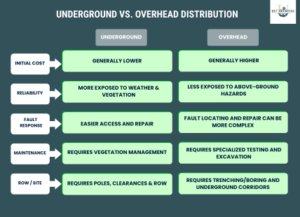
Overhead systems are more exposed to weather, vegetation, and other above-ground hazards, which can result in more frequent faults. However, damaged equipment is generally easier to locate and access, supporting faster repairs.
Underground systems may experience fewer interruptions from certain above-ground hazards, but underground faults can take longer to locate and repair.
Utilities can evaluate these differences using reliability metrics such as SAIFI (System Average Interruption Frequency Index), SAIDI (System Average Interruption Duration Index), and CAIDI (Customer Average Interruption Duration Index).
Overhead faults are often temporary and may clear through protective device reclosing, while underground cable faults are more often permanent and require repair.
Reliability can also be improved through feeder hardening, sectionalizing, protection coordination, and distribution automation. FLISR (Fault Location, Isolation, and Service Restoration) can help identify faults, isolate affected sections, and restore service to unaffected portions of a feeder.
Cost and Construction
Overhead construction typically involves poles, conductors, crossarms, transformers, guying, protective equipment, and ROW preparation. Underground construction may require trenching or directional boring, conduit or duct banks, underground cable, vaults, pad-mounted equipment, excavation, backfill, and surface restoration.
Rock excavation, congested utility corridors, roadway restoration, difficult soil, and specialized construction methods can increase costs substantially.
Life-cycle costs should also consider inspection, maintenance, vegetation management, outage response, equipment replacement, fault repair, excavation, restoration, and long-term operating requirements.
Existing Infrastructure and Site Conditions
New distribution facilities must be designed around existing infrastructure and physical site conditions.
Engineers may evaluate available ROW, roadway crossings, terrain, soil conditions, drainage, flood exposure, vegetation, existing utility corridors, and construction access.
For underground projects, identifying existing subsurface utilities is particularly important. Subsurface Utility Engineering (SUE) can help improve the quality of underground utility information and reduce conflicts during design and construction.
Overhead projects require field verification of existing poles, attachments, clearances, guying, transformers, communications facilities, and joint-use requirements.
Maintenance and Accessibility
Overhead equipment is generally visible and accessible to field crews, making inspection and troubleshooting relatively straightforward. Underground facilities require different maintenance methods, and cable faults may require specialized testing, excavation, and restoration.
A sound design should therefore consider how the system will be inspected, maintained, repaired, and operated throughout its service life.
Hybrid Distribution Approaches
The decision does not always have to be entirely overhead or underground. A hybrid approach can combine both configurations within the same project.
For example, underground construction may be used through a dense development or critical section while overhead facilities remain in areas where suitable ROW is available. Riser poles can also provide transitions between overhead and underground sections.
This approach can help address different site conditions while balancing construction requirements, reliability objectives, and project costs.
Which Option Fits a Project?
Overhead distribution may be practical where suitable ROW already exists, accessibility is important, construction cost is a major consideration, or existing overhead infrastructure can be reused.
Underground distribution may be appropriate where above-ground ROW is limited, aesthetics are important, local requirements call for underground facilities, or reducing exposure to certain weather and vegetation-related hazards is a priority.
Utilities may focus on reliability, system capacity, maintenance, and restoration. Developers may prioritize schedules, easements, utility coordination, and construction requirements, while municipalities may consider ordinances, streetscape requirements, aesthetics, and undergrounding programs.
How DST Engineers Supports Distribution Projects
DST Engineers supports overhead (OH) and underground (UG) distribution projects up to 35 kV, providing engineering and design support from planning through construction implementation.
DST’s capabilities include system planning and load forecasting, conceptual design and cost analysis, OH and UG line design, line relocations, reconductoring, feeder hardening, protection and coordination studies, distribution automation and FLISR readiness, field and GIS support, permitting, and ROW support.
DST also provides joint-use services, including pole attachment audits, pole loading analysis, pole placement design, make-ready design, inspections, and remediation tracking.
Conclusion
Choosing between overhead and underground distribution depends on site conditions, reliability requirements, ROW availability, construction costs, and long-term system performance. A well-planned solution whether overhead, underground, or hybrid should address the project’s technical requirements, operating needs, and lifecycle considerations.
Planning an overhead, underground, or hybrid distribution project? Talk to the DST Engineers team about your project requirements and engineering needs. Explore DST Engineers’ Distribution Engineering Services
Frequently Asked Questions
1. Is underground power more reliable than overhead distribution?
Underground systems can reduce exposure to certain above-ground hazards, while overhead systems are generally easier to access when faults occur. Reliability depends on the specific system, hazards, and operating conditions.
2. How much more expensive is underground distribution?
Followed by a short explanation that soil, utility congestion, boring, paving, and restoration can change the final cost. Trenching, boring, duct banks, utility conflicts, difficult soil, and restoration requirements can significantly affect project costs.
3. What are common underground distribution problems?
Common concerns include accidental excavation or dig-ins, cable aging, splice and termination failures, water intrusion, flooding, corrosion, and thermal limitations.
4. Can a project use both overhead and underground distribution?
Yes. Hybrid systems can use underground facilities in constrained or critical areas while retaining overhead construction where ROW and site conditions make it practical.
5. How does DST Engineers support distribution projects?
DST Engineers provides OH and UG distribution design, system planning, feeder hardening, protection and coordination, GIS, permitting, ROW, field support, and joint-use services for projects up to 35 kV.